
NBA combo props explained: PRA, P+R, P+A and R+A

A combo prop adds a player's stats into one line: PRA means points plus rebounds plus assists; P+R, P+A and R+A combine two. Another stat can cover a shortfall, but reduced minutes affect every part. Research playing time first, then the hit rate at the exact line and the price.
What PRA, P+R, P+A and R+A mean
The sportsbook sets a total for the combined stats. An over needs to finish above it; an under needs to finish below it.
For an illustrative game with 22 points, eight rebounds and six assists:
| Market | What counts | Game total |
|---|---|---|
| PRA | Points + rebounds + assists | 36 |
| P+R | Points + rebounds | 30 |
| P+A | Points + assists | 28 |
| R+A | Rebounds + assists | 14 |
That clears over 35.5 PRA but misses over 28.5 P+A. A half-point line can't tie; an exact tie on a whole-number line is generally a push, with the stake returned. Check your sportsbook's settlement rules.
Why minutes matter on every part of a combo
A combo can look like insurance against a cold shooting night. But rebounds and assists don't protect you from a player sitting on the bench.
Foul trouble, a minutes restriction or an early exit can reduce opportunities across the entire combination. The first question is how much he'll play, not just his average total.
Check recent minutes and any announced restrictions. A back-to-back deserves attention, but doesn't automatically mean fewer minutes. The rest and schedule guide explains what to check rather than assuming a tired player must go under.
Match the combo to the player
A lead guard's scoring and passing make P+A a useful market to investigate. For a scorer who rebounds but creates few shots for teammates, P+R may be easier to assess. R+A isolates rebounding and passing; PRA includes everything.
Those are research starting points, not betting rules. Adding a weak category doesn't make the bet worse by itself, because the line and price change too.
If points dominate the combo, ask what the other categories contribute on low-scoring nights. Familiarity with a player doesn't establish value.
Teammates out, pace and game script
An absent teammate can change who handles the ball, takes shots or plays more minutes. Those opportunities aren't distributed evenly. A replacement starter may gain minutes without gaining the missing player's offensive role. Check the lineup and how injuries change player props.
Pace means possessions per game. More possessions offer more opportunities, but don't ensure that a particular player gets them. See the basketball statistics guide.
The spread offers context about the expected margin, not a forecast of the final score. A close game may preserve a starter's late minutes; a blowout may cut them. Don't count those minutes as certain.
A worked example: different combos, the same miss
On November 11, 2026, two Nolan Traore checks for Brooklyn at New Orleans showed six hits in seven games. One combined points and rebounds; the other combined points and assists. Their underlying results were:
| Opponent, oldest first | P+R, over 14.5 | P+A, over 15.5 |
|---|---|---|
| At Boston | 16: hit | 18: hit |
| vs Detroit | 11: miss | 11: miss |
| At Indiana | 18: hit | 22: hit |
| At New York | 20: hit | 21: hit |
| vs Charlotte | 20: hit | 18: hit |
| At Atlanta | 20: hit | 21: hit |
| At Dallas | 15: hit | 16: hit |
The P+R check and P+A check missed against the same opponent, Detroit. Swapping rebounds for assists didn't change which games cleared these particular lines.
That's a reason to compare the logs, not proof that the bets are interchangeable. The thresholds differ, and both combinations include points. These totals alone don't reveal how many points he scored or whether reduced minutes caused the miss.
Seven games can't establish how often combos rescue low-scoring nights across the NBA. To answer that for your player, compare a single-stat log for the same games and check minutes separately. More categories don't automatically mean independent protection.
Hot combo streaks still need the line and price
A historical hit rate counts past games at a threshold. It isn't the probability of the next result. Read how to interpret prop hit rates before treating five of seven as a forecast.
The number matters. A streak above 26.5 doesn't establish the same record above 29.5. At -170, you risk $170 to win $100, requiring about 63% wins to break even before pushes.
That's 170 divided by 270. It isn't evidence that a player has a 63% chance. Use the player prop calculator for price math and the line-shopping guide to compare the same market across books.
Alternate combo lines and same-game parlays
An alternate line is another threshold for the same market. Holding everything else equal, a lower over is easier to clear. Easier doesn't mean better value.
With integer stats, 20+ P+R and over 19.5 P+R describe the same threshold. Over 20.5 requires 21.
Combining a player's points over and PRA over in a same-game parlay creates overlapping exposure. The legs share points and playing time, so don't multiply their individual hit rates as if they were independent. Read the correlated-props guide; a payout calculator doesn't estimate their joint chance.
How to run a combo check on WagerLens
Start with today's NBA props or Bet Check. Confirm the matched player, combo, side and line.
This real Nolan Traore P+A check showed six of seven above 15.5 when captured November 11, 2026. It labeled 15.5 an alternate line while most books showed 14.5. The screenshot's +102 BetRivers quote was timestamped 10:03 AM ET and still updating, not a standing offer.
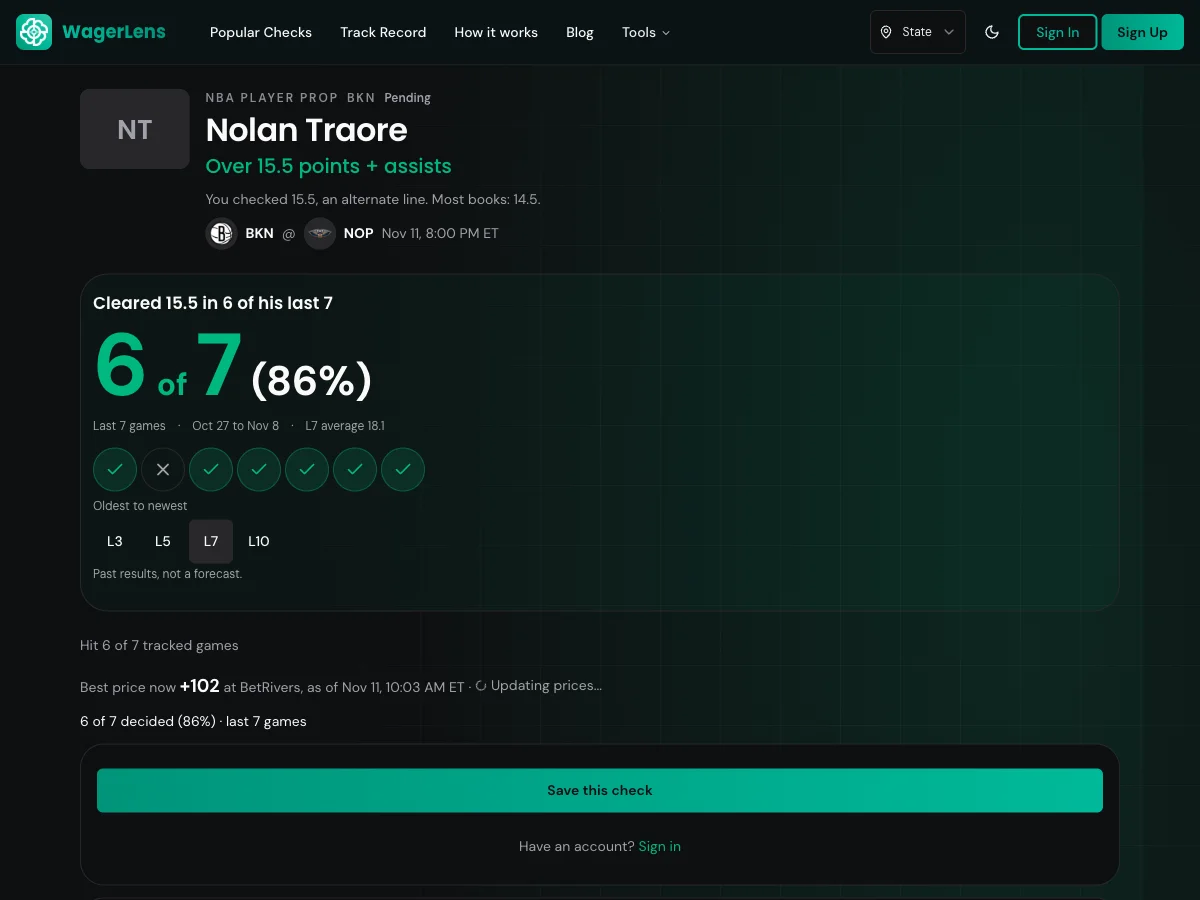
Open the image full size for small text. Don't mix its seven-game sample with another window.
- Read the hits and sample size together, then inspect individual results.
- Compare the same games with the player's points, rebounds or assists log. Don't infer minutes from totals alone.
- Check current injury information separately. Verify the line, quote time and price at the sportsbook.
- Choose Save this check to revisit it. Saving is free with an account.
Current sportsbook quotes are available free; Premium adds per-book price history and line movement. Missing or stale quotes aren't current offers. The Bet Check user guide covers the evidence view.
Check a combo free, then save the research if you want to return to it. A pass is a useful outcome too.
FAQ
What does PRA mean in NBA props?
PRA stands for points plus rebounds plus assists. Add the player's totals in those categories and compare the sum with the sportsbook's line. A player with 20 points, nine rebounds and five assists has 34 PRA. That clears over 32.5 but falls short of over 34.5.
What's the difference between PRA, P+R, P+A and R+A?
PRA adds points, rebounds and assists. P+R combines points and rebounds; P+A combines points and assists; R+A leaves scoring out and adds rebounds and assists. Each market has its own line and price. A combo that suits a player's role still isn't automatically a better-priced bet.
Why can a combo hit when a points prop misses?
Rebounds or assists can cover a scoring shortfall if their combined total is enough to clear the combo line. But the sportsbook sets a separate, higher line for that combination. Adding stats doesn't guarantee protection, especially when reduced playing time limits opportunities for every part of the bet.
Why do blowouts and foul trouble hurt combo props?
Foul trouble or an early exit in a blowout can reduce playing time, leaving fewer chances to score, rebound or assist. Those shared minutes are why a combo isn't a hedge against sitting out. This can hurt an over, but it doesn't make an under a sure thing.
How do I research an NBA combo prop on WagerLens?
Open Bet Check and confirm the player, combo, side and exact line. Read hits alongside the number of tracked games, inspect the game log, and compare the relevant single-stat results. Check the quote time and price at your sportsbook. Save this check free with an account to revisit the research.
Is a long combo hit streak enough to bet the over?
No. A seven- or ten-game streak is a small sample, not the chance of winning the next bet. Check whether the streak uses today's exact line and whether the player's role has changed. Then calculate the win rate required by the available price. Passing is a valid conclusion.
Past results aren't a forecast. WagerLens provides research, not picks.
21+ | 1-800-GAMBLER
See it live before you bet
NBA props with best prices, hit rates with sample sizes, and a public track record.
- Every pick graded — wins and losses, no filters
- Hit rates for the exact line and recent windows
- Sportsbook price comparison on free Bet Checks
- Premium adds tracking, history and stats, and alerts
- Public track record with wins and losses